
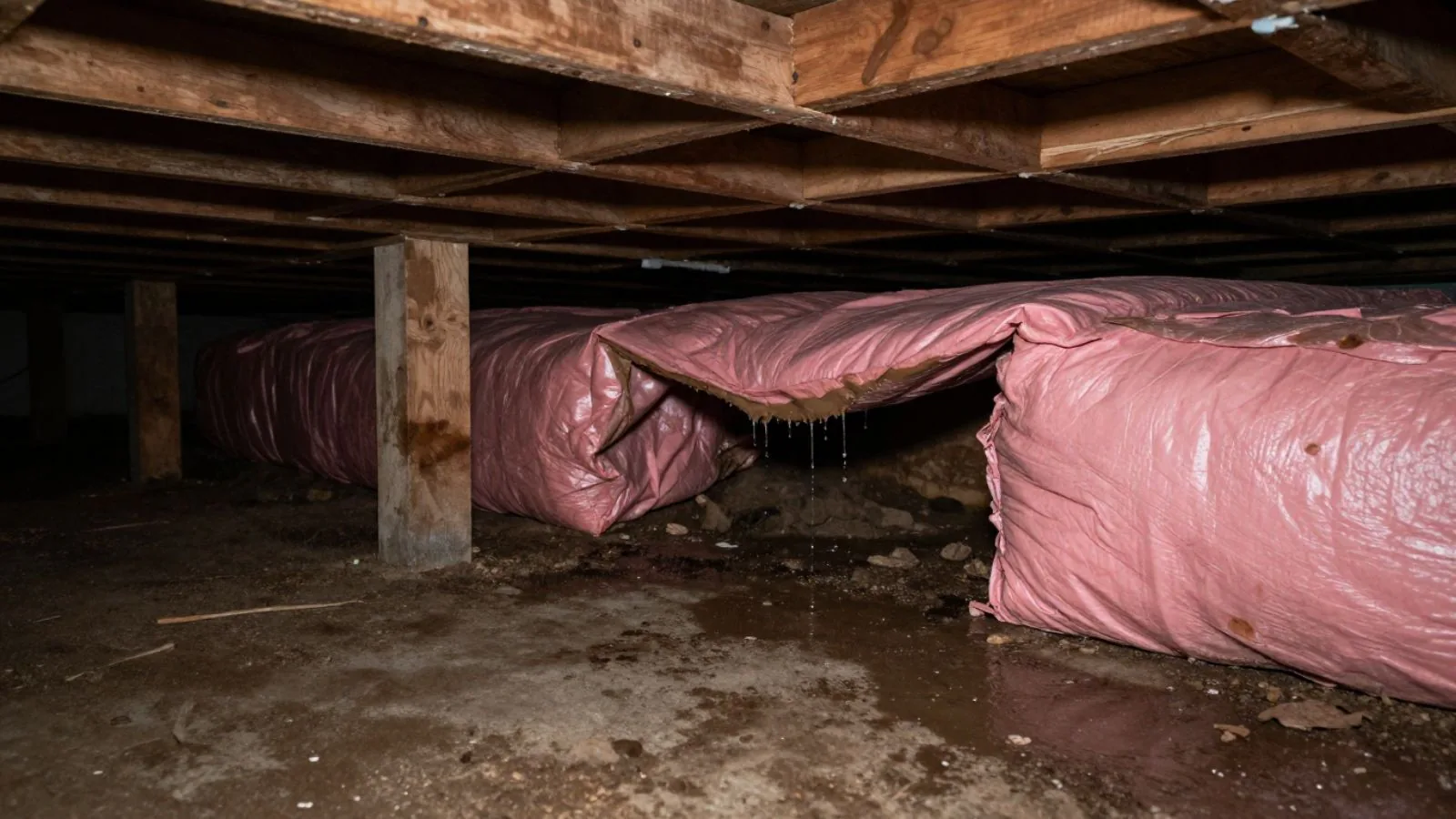
What water in a crawl space does to the house above
A crawl space is the shallow void between the ground and the first floor. When water gathers there, it soaks insulation, wets the wood framing and raises humidity in the air that rises into the home. Floors above can cup, squeak or feel cold and damp, and the space gives off a damp smell.
Because the space is cramped and dark, problems often go unnoticed until a floor feels soft or an odor appears upstairs. Water that sits in a crawl space can also reach pipes and ducts, which makes it worth checking whenever a plumbing leak or heavy rain has occurred.
Where the water comes from
Groundwater and heavy rain
Water enters through foundation vents, cracks or a low grade and collects on the ground.
Plumbing leaks
A leaking supply or drain line drips onto the ground and onto insulation.
Appliance and HVAC drains
Condensate lines and appliance hoses can terminate in the crawl space.
Humidity and condensation
Warm humid air meets cooler surfaces and condenses, wetting wood and insulation without any pooled water.
The source decides the fix. A leak is repaired by a plumber, groundwater is a drainage matter and condensation is a ventilation and moisture-control matter. We deal with the wet structure these problems leave behind.
How we clean up and dry a crawl space
- Remove standing water with a small submersible pump or wet vacuum, working in the limited space.
- Check the joists, subfloor and sill with moisture meters and note which framing is wet.
- Remove wet insulation, which rarely dries while it is compressed against the floor.
- Dry the space with dehumidifiers and air movement, and ventilate it as the conditions allow.
- Photograph what we find, since crawl space conditions are hard for others to see.
Restoration is not waterproofing. Our work removes water and dries what it soaked. Stopping groundwater from returning is a separate drainage or waterproofing job, which a specialist handles.
Crawl space flooded after a storm or leak?
Call us. The line is open 24/7 and we can explain what we would check and what you can safely do from above.
Vapor barriers, insulation and what stays
Many crawl spaces have a plastic vapor barrier over the ground and insulation between the joists. If water sits on top of the barrier, it must be removed, and the barrier may need to be cleaned or replaced. If insulation soaked up water and slumped, it holds moisture against the subfloor and is removed.
Wood framing is usually dried in place unless it has been soaked for a long time. Moisture readings are compared against unaffected wood to see whether drying has finished. A crawl space can also affect the floor above, which is covered on the hardwood floor page and the structural drying page.
Crawl spaces in and around South Orange
We have no figure for how many South Orange homes have crawl spaces rather than full basements. They tend to appear under additions, porches and some smaller older houses, so the best test is to look under your own home. If you have one, rainfall matters. Newark airport records about 123 days a year with measurable precipitation, and a wet spring or a storm like the September 2021 Ida remnants can leave water in a low space for days.
The East Branch of the Rahway River flows the length of South Orange and the Village notes low-lying areas, so homes near the river corridor are worth checking after heavy rain. Our flood damage cleanup page explains how river water changes the plan.
What the industry standard says
The ANSI/IICRC S500 standard covers crawl spaces as part of the structure, so moisture readings in joists and subfloor guide the drying plan. Where the space has been wet for a long time, the standard also points toward a separate look at microbial growth.
What to do before help arrives
- Do not enter a crawl space with standing water or exposed wiring.
- Shut off the water supply if a pipe is the source.
- Turn off power to the area at the panel only if you can do so while standing on dry ground.
- Keep children and pets away from the access hatch.
- Take photos from the hatch and note how deep the water looks.
These steps are about safety and keeping the damage from growing. They are not a substitute for the instructions of your utility, fire department or electrician.
What shapes the cost
Water volume
Standing water takes more pumping time than damp ground.
Access
A small hatch or a low clearance slows work.
Insulation involved
Wet insulation must be removed and replaced.
Source and category
Clean water is simpler than water that carries soil or drain waste.
Drying needs
Wood and soil dry slowly, which affects equipment days.
Insurance note: coverage depends on your policy and on what caused the loss. The New Jersey Department of Banking and Insurance states that homeowners policies exclude water damage caused by flood, which needs separate flood coverage. Insurance may also treat groundwater and gradual seepage differently from a sudden pipe failure.
Want your real number? Call (973) 913-7965. We explain scope and price before work starts.
Frequently asked questions
Is water in my crawl space an emergency?
It can be. If water is still entering, if it reached pipes or ducts or if a floor above feels wet, call right away. Our line is open 24/7.
Can you prevent water from coming back?
We remove water and dry the space. Preventing recurrence is a drainage or waterproofing job, and we will tell you honestly if that is what your crawl space needs.
Do I need to replace the insulation?
If it soaked through and sagged, usually yes. Wet insulation does not dry reliably against the floor.
How do I know if the crawl space is damp?
A musty smell, soft or cold floors and visible moisture on framing are common signs. A moisture meter gives a firmer answer.
Will the floor above be affected?
Sometimes. Wood floors can cup and subfloor can soften, and we check both when the crawl space is wet.